
Specifications
| Specification | Value |
|---|---|
| Press types | Cubic press (HPHT), toroidal press (HPHT) |
| Material | Sintered tungsten carbide (WC‑Co), virgin or reclaimed grade to suit the application |
| Made at | Unit 1, Navsari, Gujarat, India |
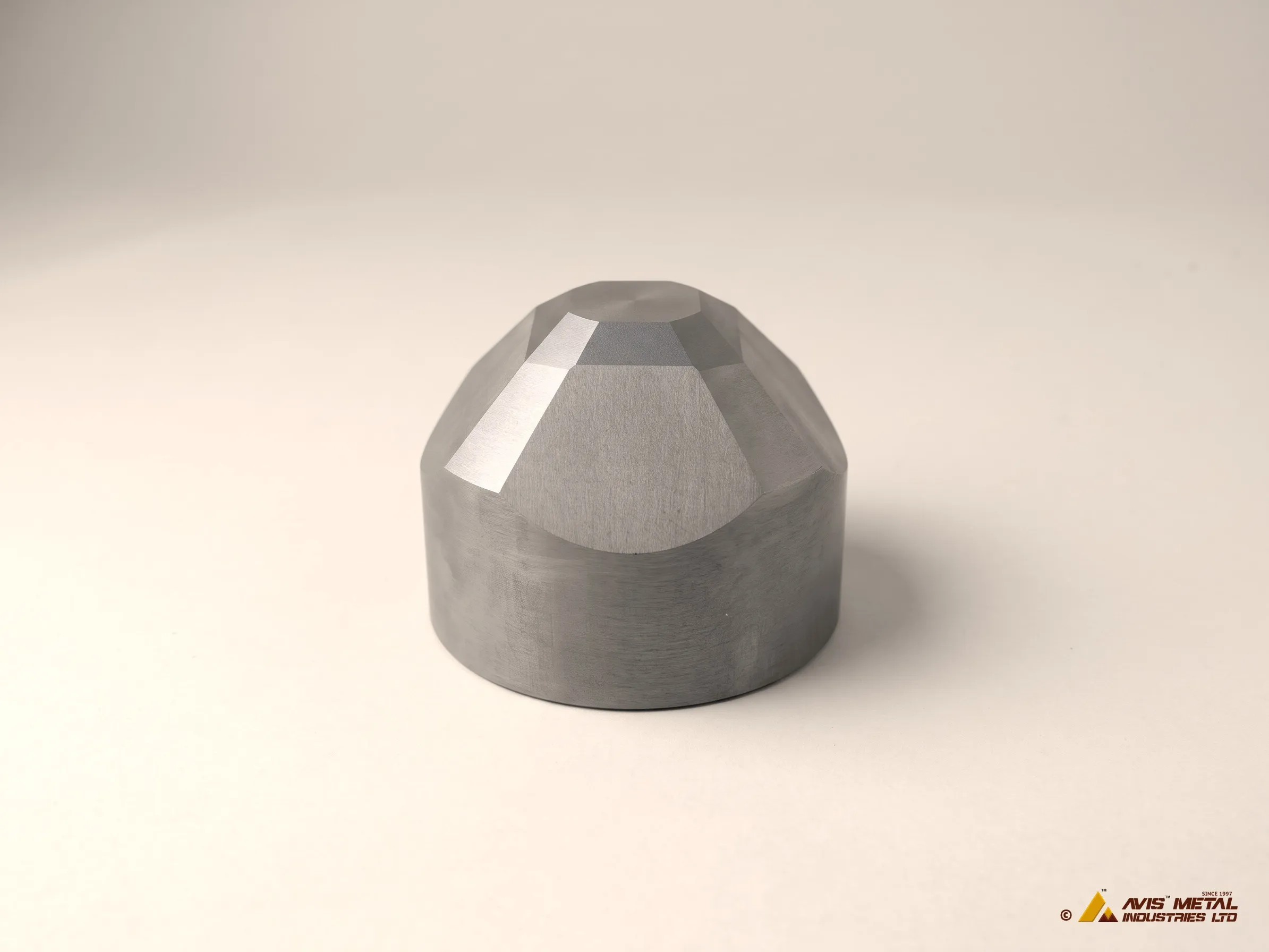
Tungsten carbide high-pressure, high-temperature (HPHT) anvils for synthetic diamond presses, for cubic presses and toroidal presses.
Or call +91 70432 16200 (Unit 1, tools) · info@avismetal.in
| Specification | Value |
|---|---|
| Press types | Cubic press (HPHT), toroidal press (HPHT) |
| Material | Sintered tungsten carbide (WC‑Co), virgin or reclaimed grade to suit the application |
| Made at | Unit 1, Navsari, Gujarat, India |
In a high-pressure, high-temperature (HPHT) press, tungsten carbide anvils squeeze a small cell in which synthetic diamond grows. They carry some of the heaviest repeated loads of any carbide part. An anvil rarely wears out; it usually fails by cracking after many press cycles. When one breaks in a cubic press, it can damage the anvils around it, so consistent quality across a set matters as much as the life of any single anvil.
We make tungsten carbide HPHT anvils for both cubic presses and toroidal presses. They are used in synthetic diamond production, superhard material processing such as cubic boron nitride, and high-pressure research. Anvil carbide needs very high compressive strength and stiffness, an even structure without pores, and good thermal conductivity to carry heat away from the cell. Exact geometry and an undamaged surface finish remove the marks where cracks begin. Press practice counts too: alignment, consistent gaskets and smooth loading all add cycles. Ordering anvils as matched sets, from one production lot, helps every face meet the cell evenly. That reduces the uneven loading that starts cracks at the edges.
Anvils are made at Unit 1, Navsari, to your press drawing, and checked for density, hardness and structure in our laboratory.
Used in high-pressure, high-temperature (HPHT) presses for synthetic diamond production and superhard material research. Tell us your press type and send your anvil drawing, and we will quote.
Yes, both.
Mostly from repeated loading cycles, uneven load from misalignment, flaws in the carbide, grinding damage and sudden temperature changes.
Yes. Send the drawing and your press details.
Work with Avis
Send a drawing, a grade, a size or just a description. Our engineers reply with a specification and a quotation.