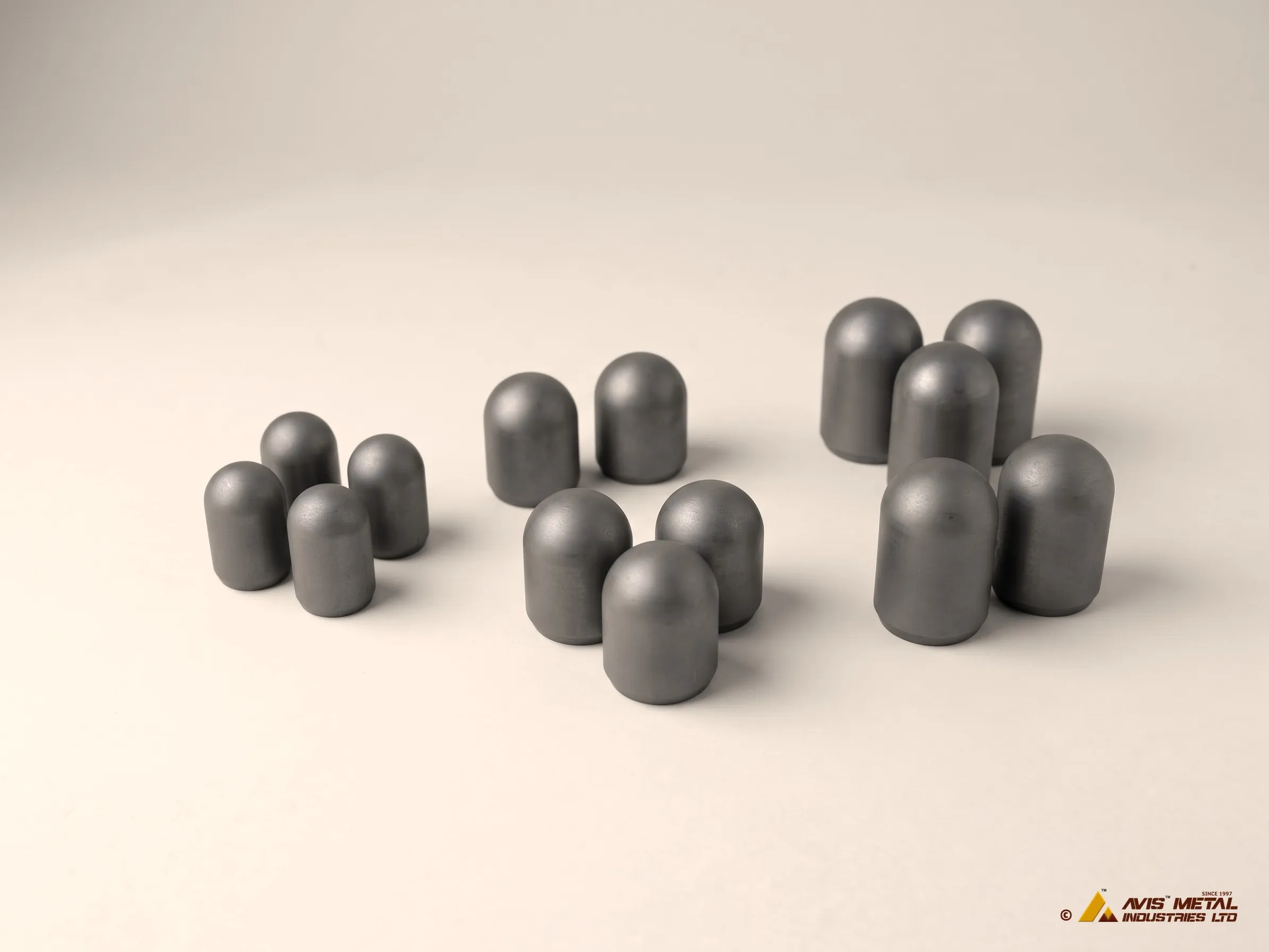
In down-the-hole (DTH) drilling the hammer sits just behind the bit and strikes it many times a second, while the rig turns it. Each blow passes into the rock through small tungsten carbide buttons pressed into the bit face. The buttons crush the rock; the steel body only holds them in place. Button life therefore decides how many metres a bit drills before it must be reground or replaced.
We make tungsten carbide buttons for DTH button bits used in rock and geotechnical drilling, and for rotary and percussion drill heads. Avis has developed mining grades for Indian geological conditions. They work in hard formations such as granite, basalt, sandstone and quartzite, and in soft formations such as limestone and coal. As a general rule, rounded (spherical) buttons suit hard, abrasive rock, while more pointed (ballistic) buttons penetrate faster in softer ground. Percussion work always calls for a tough grade. The press fit of each button in the bit body is just as important. A button that is loose in its hole can rock under impact, crack at its base or fall out.
Buttons are made at Unit 1, Navsari, and checked in our laboratory for density and hardness.